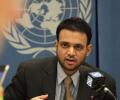
The 36-year-old desi speaks impeccable Arabic and quotes freely from the Quran during his speeches, reports Aziz Haniffa.

Even as Prime Minister Nawaz Sharif headed to the United States for the 70th session of the UNGA and for bilateral meetings to be held on the sidelines of the multilateral summit, back home all that is expected of him is to internationalise the Kashmir issue, or as Pakistan puts it, the 'Kashmir dispute'.

In the Russian president's eyes, it sends a message of defiance to the world and his own people which fits his favoured storyline: Russia is succeeding despite Western efforts to hold it back.

Ambassador Islam 'Isi' Siddiqui, one of the highest ranking Indian Americans in the Obama administration, has resigned from his position as chief agricultural negotiator in the office of the United States Trade Representative.

The Indian intelligence brass may have snared a key Pakistani spy and Jadhav's arrest is Pakistan's way of getting even with India, says Rajeev Sharma.
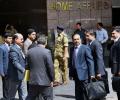
If Pakistan allows India to send its investigation team to question Azhar it would take the India-Pakistan camaraderie to a new level, says Rajeev Sharma.

My goal is to implement the Sevak project all over India and make the villages true Gandhian villages -- self sustainable in every way, including health, says Dr Thakor Patel, head of the American Association of Physician of Indian Origin's Public Health Committee. Aziz Haniffa reports

He also said it was for India to decide on dates for Foreign Secretary-level talks, postponed in the wake of the terror strike.

Asked if the relationship has achieved its full potential, the President replied, "Absolutely not."

'The US-India relationship is in a different league altogether,' Obama administration officials tell Aziz Haniffa/Rediff.com in Washington, DC.

'The biggest stumbling block will come from the traditionalists in the Pakistan army who have grown on a diet of anti-Indian propaganda and thinking on which much of their role -- both militarily and politically -- is centered upon.'

"The basic idea is that India would like to continue to be the most beautiful woman wooed by all men, notably the two strongest in the house, US and China," the article titled 'Indo-US strategic distrust stalls LSA signing'.

United States President Barack Obama on Saturday warned lawmakers against turning "a blind eye" to chemical attacks in Syria as he made a strong pitch to war-weary Americans for "limited" strikes in the strife-torn country.

'We use the word "historic" perhaps too much, but the prime minister's visit certainly was historic in so many ways.'

With Pakistan moving towards tactical nuclear weapons, there is an increasingly higher risk of nuclear theft, a US think-tank report has warned ahead of the Nuclear Security Summit in Washington later this month.

The Islamic State group has released a video showing the beheading of US aid worker Peter Kassig in a warning to Washington as it prepares to send more troops to Iraq.
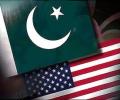
US Assistant Secretary of State for South and Central Asia Nisha Desai Biswal believes the India-US nuclear deal is not in limbo and it is for India and Pakistan to set the pace for conversations to resolve their issues. Rediff.com's Aziz Haniffa reports from Washington, DC.

Magnificent death bowling saw Mumbai Indians snatch an incredible one-run victory from the jaws of defeat against Rising Pune Supergiant in a thrilling final of the Indian Premier League, in Hyderabad, on Sunday.

Prime Minister Narendra Modi and United States President Barack Obama will meet on Sunday, January 25, at Hyderabad House a few hours after the American leader's arrival in New Delhi.
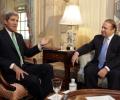
Pakistan Prime Minister Nawaz Sharif continues his exhortation for US mediation in Kashmir, and harks back to his meeting with former Prime Minister Atal Bihari Vajpayee when the latter had agreed to a resolution of Kashmir imbroglio; senior us officials assert there is 'absolutely no change in us policy' that Kashmir has to be resolved bilaterally. Aziz Haniffa reports.

India is committed to getting back to a sustainable growth path of 8 to 9 per cent, Prime Minister Manmohan Singh has said, adding that such a target is achievable because the fundamentals of the Indian economy remain strong.

'Most of the agitations are staged by the Opposition to disturb the peace of the state.'

'Modi wants to be pragmatic -- acknowledge the problem of Pakistan and that full reconciliation is essentially a non-starter, but at the same time grab the low-hanging fruits (such as trade) to put things on a more even keel, to engender enough stability in the relationship to allow him to focus on other priorities.'

Here's the full text of Prime Minister Narendra Modi's address to the United States Congress.

Here are some of the best photos from around the world in the month gone by...

'We will have to wait till the snows melt in June/July 2016 before we can get a clearer idea of whether Pakistan intends to get serious about ending support for cross-border terrorism,' says G Parthasarathy, India's former high commissioner to Pakistan.
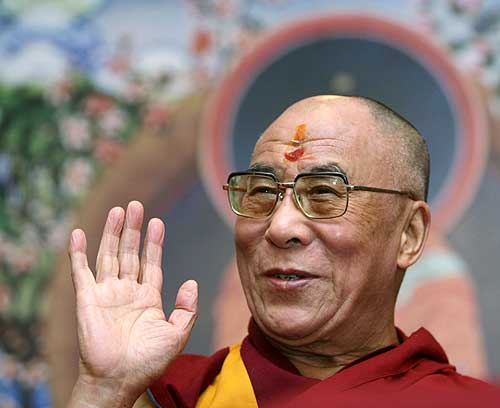
'The first time that China alleged the Dalai Lama was 'anti-national' and 'unpatriotic' was after he affirmed that Arunachal Pradesh and Tawang are part of India,' points out former RA&W official Jayadeva Ranade.
